Scans help to authenticate rare Tang Dynasty silver statuette of China’s only female emperor
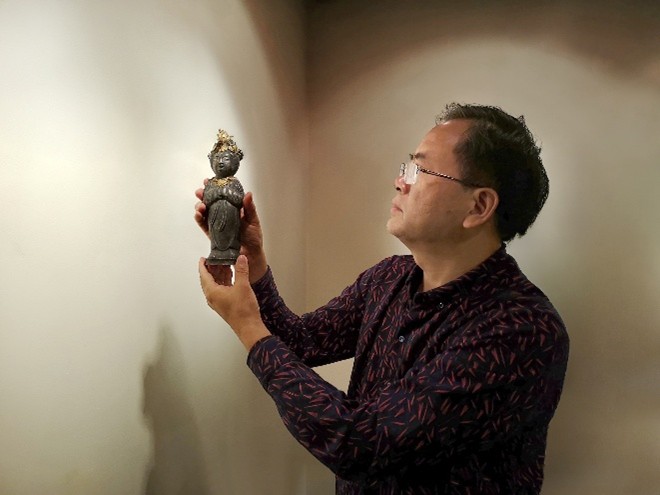
In a remarkable intersection of cutting-edge industrial inspection technology and ancient art history, X-ray CT (computed tomography) has played a pivotal role in identifying what is believed to be the only known gilt silver statuette of China’s sole female emperor, Wu Zetian (624–705). The artefact, a 25cm tall statuette currently privately owned in Britain, has long been a subject of scholarly interest. To verify its construction and hence its authenticity without damaging the unique and valuable relic, researchers turned to advanced, non-destructive testing offered by the Industrial Solutions Business Unit of Nikon Corporation.
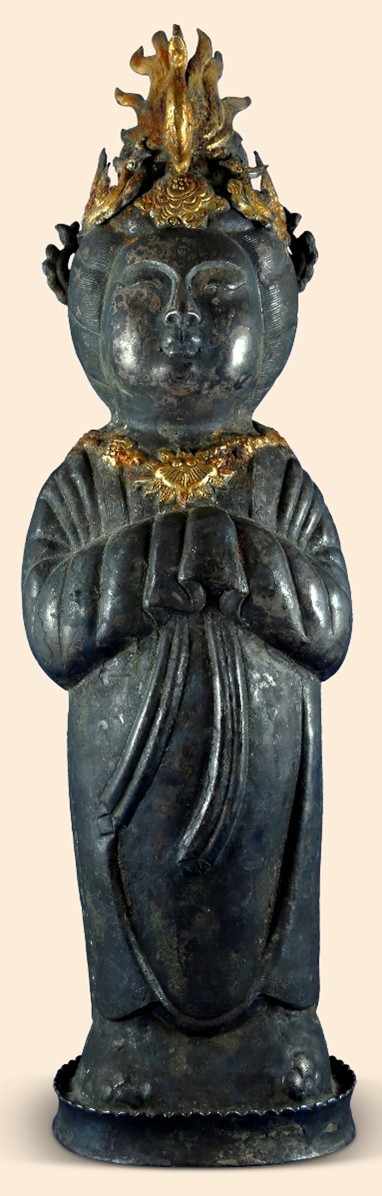
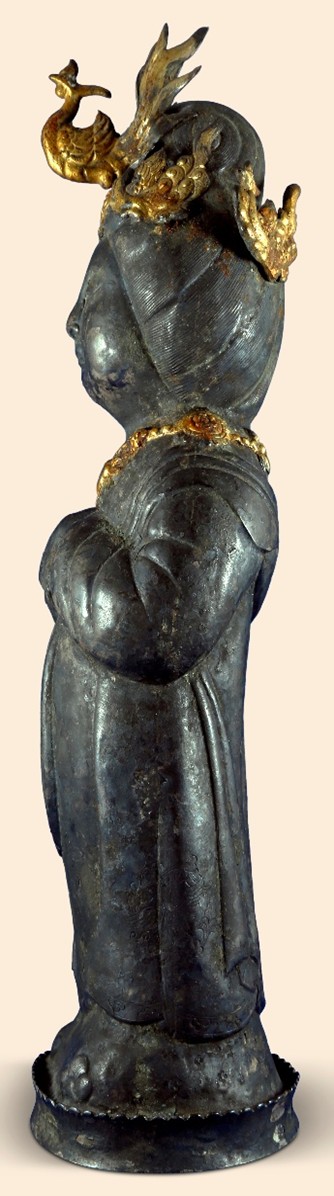
Tang Dynasty silver statuette
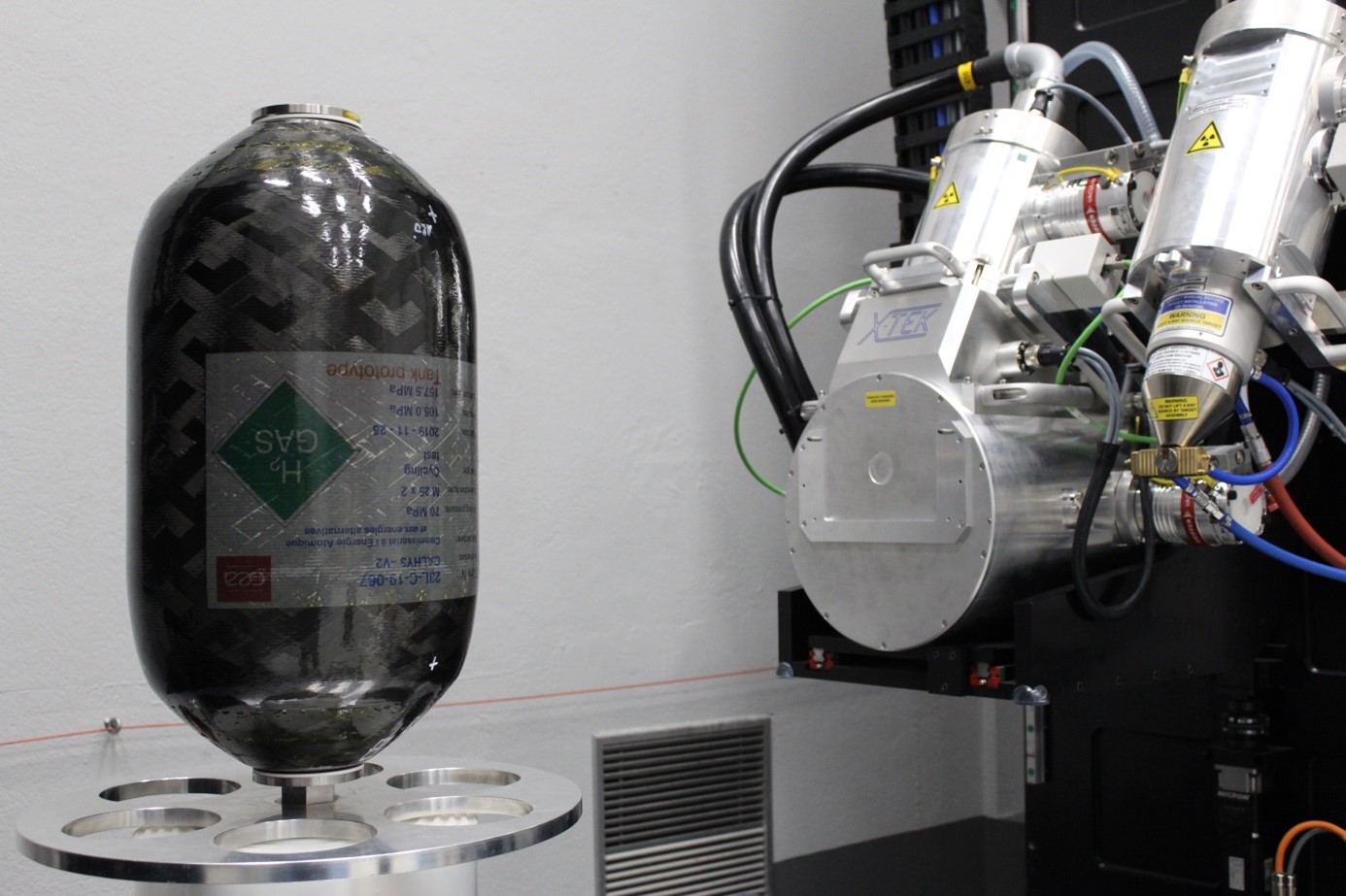
At Nikon’s Tring factory, demonstration facility and test laboratory in England, one of the company’s X-ray CT specialists, Andrew Ramsey, conducted a suite of three high-voltage, high-resolution scans at different magnifications in a pair of Nikon microfocus CT systems. The silver statuette was inspected three times.
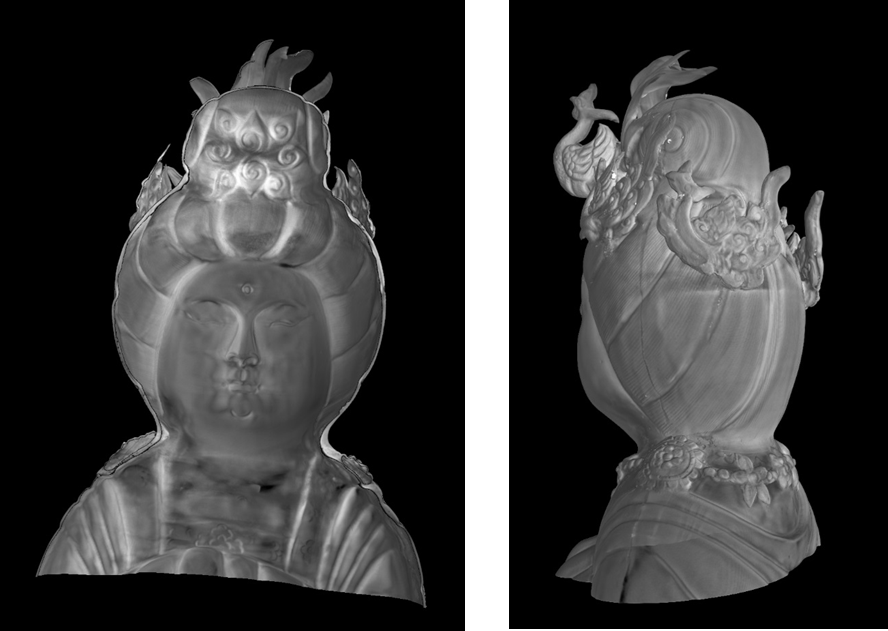
The two first inspections were carried out on a Nikon XT H 450 system, the predecessor system to the current VOXLS 40 C 450. The first scan, a 36-minute, circular cone-beam scan from top to bottom, was performed at 355 kV and 95 W at a resolution of 140 µm. A similar scan of the head, an area of particular interest, was carried out using the same voltage but at a higher resolution of 65 µm. Lastly, a helical scan of the head was completed in 26 minutes in another Nikon X-ray CT system, the XT H 320, featuring a lower voltage source but a higher efficiency detector. The parameters used were 205 kV, 35 W and an even sharper resolution of 36 µm.
To enable a well-defined view of the interior of the dense silver alloy specimen, all scans were made through a 2 mm thick tin filter in front of the source, which removed low energy X-rays to increase the penetration of the beam and hence the clarity of the images. Typically, raising the voltage of the source alone has little effect on the mean energy of the beam, as it simply generates more lower energy rays as well as higher energy ones. The filter preferentially removes the unhelpful, lower energy rays that would otherwise not penetrate the sample and may cause artefacts.
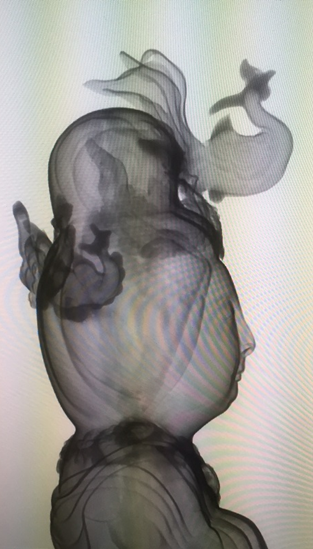
The resulting 3D CT volume provided a digital image of the statue of the female emperor that would have been impossible to achieve by other means. The uniform greyscale of the CT slices confirmed that the statue’s monolithic construction was of a consistent material density and was crafted from a single source of metal, proving the shell was not pieced together from different or modern parts. Additionally, internal views revealed air bubbles in the solder flux where decorative elements were brazed and soldered onto it. Such bubbles are characteristic of authentic medieval soldering methods. These findings provided the scientific certainty that the artefact has maintained its original form and is not a recent reconstruction or a high-quality fake.
Visual inspection of the statuette had already allowed historians Wang Shuanghuai, Professor of History at Shaanxi Normal University in Xi’an, China, and Fang Jun, Professor of History at Huron University in Ontario, Canada, to confirm that the physiognomic features, including draconic eyes, broad face and square forehead, and other physical markers such as a phoenix neck, match historical descriptions of Wu Zetian in ancient texts. Likewise, the clothing and headdress were noted to be comparable with ceremonial apparel of the time.
Watch a video of the 3D CT volume : https://youtu.be/RHMfTIBTdvY
In a third prong of the multidisciplinary investigation, Dr Peter Northover, a former Research Fellow at the University of Oxford’s Department of Materials, used electron probe microanalysis to examine a small sample of the silver alloy taken from the base of the statuette. The density of the alloy and the proportions of red copper (4.21%), zinc (0.05%) and lead (0.11%), plus the presence of trace amounts of other elements, were consistent with known silver artefacts from the Tang Dynasty, providing further scientific evidence for the statuette’s authenticity and age. Moreover, the metallographic analysis determined that the thin, corroded patina on the surface was a result of natural aging over centuries, rather than a modern chemical treatment contrived to make a new object look old.
Ultimately, these metallurgical findings, alongside visual inspection and the high-voltage X-ray scans performed by Nikon, helped to verify that the statuette is a genuine historical relic, rather than a modern forgery. It supported the conclusion that it is a rare, authentic, early medieval depiction of Wu Zetian, China’s only female emperor to rule in her own right, a unique feat in the country’s long history of male-dominated imperial rule. While other women held power as empress dowagers or regents, Wu Zetian was the sole woman in China’s history to be officially crowned emperor.
Supporting information
Professor Wang was in attendance when the silver statuette was scanned, and the X-rays were reconstructed at Nikon’s Tring facility. He felt that it would be worthwhile to elaborate on two of the key findings during analysis of the CT scans. Speaking from Shaanxi Normal University, he explained the following points:
“Identification of a single metallic source is fundamental to scientific authentication of antiquities, as it shifts the process from subjective stylistic appraisal to objective material analysis. With CT scanning, researchers identified a uniform greyscale distribution that confirms a high degree of consistency in the object’s density and chemical composition. This discovery acts as a powerful tool for validation by eliminating modern forgeries, as replicas often possess material inconsistencies that contradict historical logic and cannot replicate the intrinsic unity found in genuine historical relics.”
“Beyond ruling out forgeries, establishing that the silver alloy came from one source serves as a foundation for researchers to connect an isolated artefact to specific mineral origins, historical eras and the socio-economic conditions of the time. Ultimately, confirming that a statue is composed of a single material safeguards the integrity of the relic as a repository of historical data and provides a solid basis for subsequent chronological dating.”
“Regarding the ancient welding techniques used on the statue, the analysis found that decorative elements were attached using a gold-silver brazing flux, which resulted in the formation of residual bubbles. These bubbles are considered a natural signature of Tang Dynasty craftsmanship, as they were caused by the decomposition of flux agents like borax, or by limitations in ancient temperature control.”
“In validation, these bubbles are positive indicators of age. Authentic bubbles typically exhibit irregular shapes and rough inner walls, whereas their total absence or a perfect appearance suggests a modern forgery. By using high-resolution CT data to map these internal bubbles and structures, researchers could effectively verify the statue’s genuineness and deconstruct the ancient manufacturing process.”
Professor Wang’s concluding observation is that X-ray CT scanning of the statuette served to digitise the interior of the object. This can be paired with high-precision external scanning to create a digital twin of the relic, an approach that allows for a zero-loss archiving process. While external scans capture surface details like ornamentation and wear, the internal CT data reveals hidden structures, not just related to density and weld bubbles but also to porosity, inclusions and crack trajectories.
In addition to aiding preservation for posterity, digital twins provide essential evidence for studying history from a technological standpoint by reconstructing the entire manufacturing chain, from casting techniques to processing sequences. They also allow the creation of a standard artefact database, where the unique craftsmanship fingerprints of different eras and regions can be compared for more accurate dating and classification.
Furthermore, this technology supports surgical-level restoration planning and virtual exhibitions that transcend physical constraints. Most importantly, it serves as the ultimate backup for human civilization. Even if the physical object is lost to disasters or natural decay, the digital twin retains the vast majority of scientific information, allowing for continued global research and interdisciplinary collaboration.
The successful conclusions of Nikon’s high-resolution scans and the metallurgical tests undertaken by Oxford University, along with detailed historical research culminated in the publication in December 2025 of an academic paper by Professor Wang Shuanghuai and Professor Fang Jun in Monumenta Serica, a leading international journal of sinology: https://www.tandfonline.com/doi/full/10.1080/02549948.2025.2572200
Conclusion
The last word goes to the owner of the statuette who in the following conclusion explained how it came to be scanned at Nikon’s facility in Tring.
“Nikon’s scanning technology came to my attention through a television programme in the UK about a similar exercise carried out on the Antikythera Mechanism, a relic widely considered the world’s first analogue computer. It was discovered in 1901 among the wreckage of a Roman merchant ship that had lain at the bottom of the sea for over 2,000 years.”
“Andrew Ramsey was a key figure in that CT scanning project, so I decided to approach him to discuss investigating my statuette to establish its age and authenticity in order to support the conclusion that it is indeed a representation of Wu Zetian and thus a cultural relic of immense importance in China.”
“With Nikon’s help, and that of the University of Oxford, it has been possible for professors Wang and Fang to establish beyond reasonable doubt that the silver relic in my possession is genuine, at the same time solving a centuries-old mystery concerning the actual facial features of China’s only female emperor. My thanks go out to all involved for their support in this process.”